

 Image 1 of 1
Not every client who walks in is ready for trauma reprocessing, and not every crisis calls for EMDR. This training focuses on the stabilization and crisis-intervention strategies that predate any treatment modality decision: tools clinicians can use with a dysregulated or crisis-presenting client regardless of whether EMDR is ultimately the right fit.
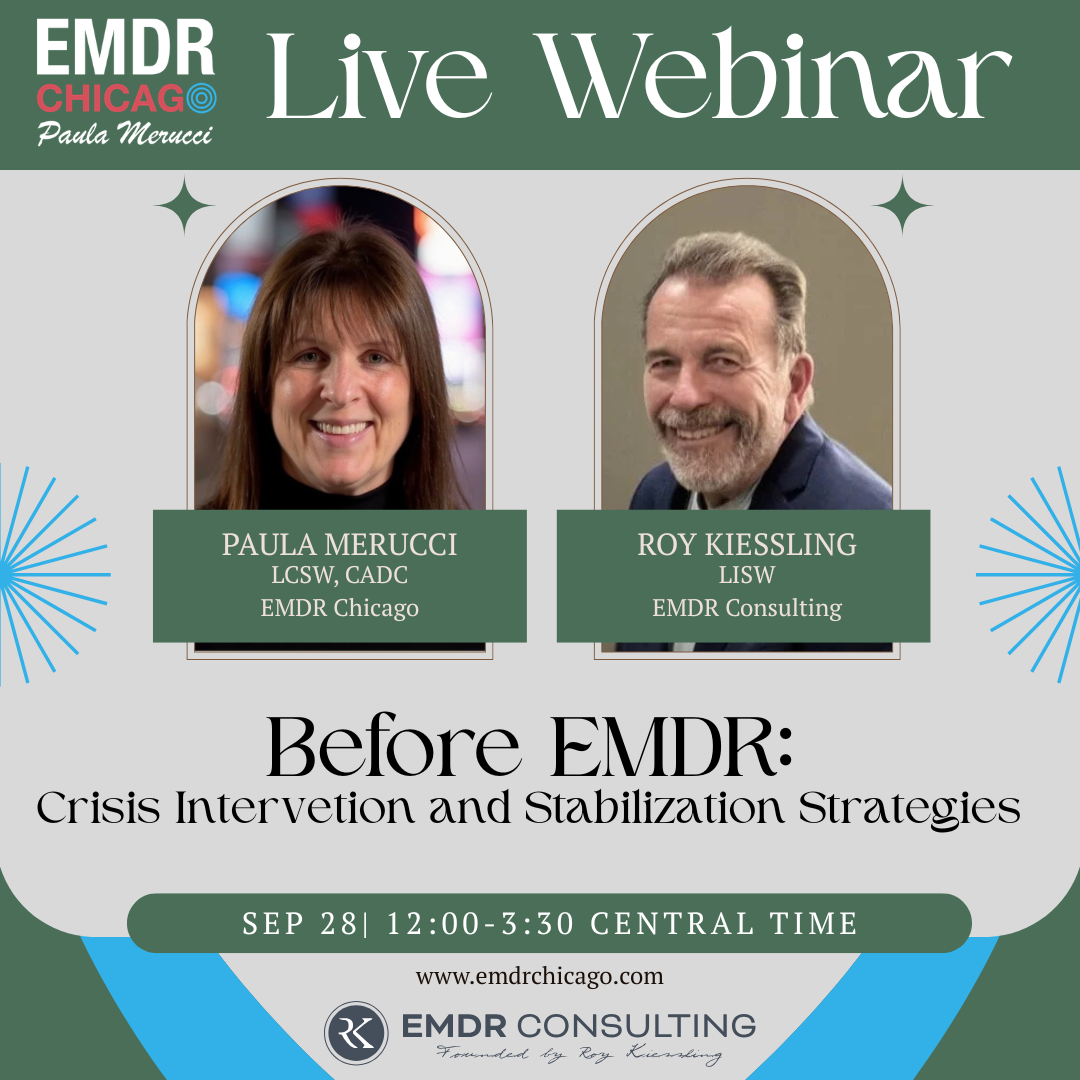
Roy Kiessling walks through a toolkit of rapid, low-risk interventions including CID (via the free WeMind CID app), A-TIP, the Modified Flash Technique, Scribbling It Out, Extended Resourcing, and the Resource Strengthening Wheel. The session also unpacks a distinction clinicians often miss: the difference between Resource Stimulation (R-Stim), used to reinforce positive material, Distracting Attention Stimulation (DAS), used to interrupt and contain an acute crisis, and the dual-attention stimulation that drives EMDR reprocessing itself. Knowing which goal you're aiming for changes how, and why, you use bilateral stimulation in the room.
The training combines lecture and slides with live clarification Q&A, open participant Q&A, and a guided practice segment in randomly assigned breakout dyads (approximately 20 minutes, 10 minutes per role) applying CID, the Modified Flash Technique, and Scribbling It Out. Slides and practice scripts are provided to all participants.
Objectives
Participants will be able to:
Differentiate between Resource Stimulation (R-Stim), Distracting Attention Stimulation (DAS), and the dual-attention stimulation used in EMDR reprocessing, and identify which is clinically indicated in a crisis moment.
Identify clinical indicators that a client is in crisis and not yet appropriate for trauma reprocessing, regardless of treatment modality.
Demonstrate at least two rapid stabilization interventions, drawn from CID, the Modified Flash Technique, and Scribbling It Out, through guided dyad practice.
Describe additional pre-treatment stabilization tools, including A-TIP, Extended Resourcing, and the Resource Strengthening Wheel, and their role in preparing a client for trauma work.
Not every client who walks in is ready for trauma reprocessing, and not every crisis calls for EMDR. This training focuses on the stabilization and crisis-intervention strategies that predate any treatment modality decision: tools clinicians can use with a dysregulated or crisis-presenting client regardless of whether EMDR is ultimately the right fit.
Roy Kiessling walks through a toolkit of rapid, low-risk interventions including CID (via the free WeMind CID app), A-TIP, the Modified Flash Technique, Scribbling It Out, Extended Resourcing, and the Resource Strengthening Wheel. The session also unpacks a distinction clinicians often miss: the difference between Resource Stimulation (R-Stim), used to reinforce positive material, Distracting Attention Stimulation (DAS), used to interrupt and contain an acute crisis, and the dual-attention stimulation that drives EMDR reprocessing itself. Knowing which goal you're aiming for changes how, and why, you use bilateral stimulation in the room.
The training combines lecture and slides with live clarification Q&A, open participant Q&A, and a guided practice segment in randomly assigned breakout dyads (approximately 20 minutes, 10 minutes per role) applying CID, the Modified Flash Technique, and Scribbling It Out. Slides and practice scripts are provided to all participants.
Objectives
Participants will be able to:
Differentiate between Resource Stimulation (R-Stim), Distracting Attention Stimulation (DAS), and the dual-attention stimulation used in EMDR reprocessing, and identify which is clinically indicated in a crisis moment.
Identify clinical indicators that a client is in crisis and not yet appropriate for trauma reprocessing, regardless of treatment modality.
Demonstrate at least two rapid stabilization interventions, drawn from CID, the Modified Flash Technique, and Scribbling It Out, through guided dyad practice.
Describe additional pre-treatment stabilization tools, including A-TIP, Extended Resourcing, and the Resource Strengthening Wheel, and their role in preparing a client for trauma work.